
CPCB Norms for STP: Discharge Standards Explained
The treated water limits your STP must meet, what each parameter means, and how to stay compliant.
Quick Answer
The CPCB STP norms notified by the Ministry of Environment, Forest and Climate Change in October 2017 set treated sewage limits of pH 6.5–9.0, BOD 20 mg/L (30 mg/L outside metro cities and listed state capitals), TSS below 50 mg/L (below 100 mg/L elsewhere) and faecal coliform below 1,000 MPN/100 mL. A 2019 NGT order directed stricter limits for new plants, and your State Pollution Control Board consent may set tighter values.
On This Page
- Who Sets STP Norms in India?
- CPCB STP Norms: Discharge Standards (2017 Notification)
- Stricter CPCB STP Norms After the NGT Order
- What Each Parameter in the CPCB STP Norms Means
- How to Make Sure Your STP Meets CPCB Norms
- What Happens If an STP Fails CPCB STP Norms?
- The Role of Pumps in Meeting Norms
- Consent to Establish and Consent to Operate
- How Treated Water Is Sampled and Tested
- Norms for Reusing Treated Sewage
- Upgrading an Old STP to Meet Stricter Norms
- Which Stage Controls Which Parameter?
- Documents to Keep Ready for Inspection
- Frequently Asked Questions
Every sewage treatment plant in India is judged by one thing: the quality of the water it releases. The CPCB STP norms define the maximum levels of pollutants that treated sewage may contain before it is discharged or reused. Fail them and the plant owner can face notices, penalties or even closure directions from the pollution control board.
This guide explains the current discharge standards, what each parameter means, the stricter norms introduced after the National Green Tribunal’s directions, and practical steps to stay compliant.
Disclaimer: This article is a general explainer. Regulations are updated from time to time and State Pollution Control Boards may set stricter conditions. Always confirm the exact limits in your own consent to operate and the latest notifications.
Who Sets STP Norms in India?
- MoEFCC (Ministry of Environment, Forest and Climate Change) notifies discharge standards under the Environment (Protection) Rules, 1986.
- CPCB (Central Pollution Control Board) develops and coordinates standards and guides the state boards. Its official website is cpcb.nic.in.
- SPCBs and PCCs (State Pollution Control Boards and Pollution Control Committees in Union Territories) issue consents to establish and operate, and enforce the norms.
- NGT (National Green Tribunal) can issue binding directions on environmental matters, including sewage treatment.
CPCB STP Norms: Discharge Standards (2017 Notification)
In October 2017, MoEFCC notified discharge standards specifically for sewage treatment plants. These are what most people mean by CPCB STP norms today. They distinguish between larger cities and other areas.
| Parameter | Metro Cities and Listed State Capitals | Other Areas |
|---|---|---|
| pH | 6.5 – 9.0 | 6.5 – 9.0 |
| BOD (mg/L) | Not more than 20 | Not more than 30 |
| TSS (mg/L) | Less than 50 | Less than 100 |
| Faecal coliform (MPN/100 mL) | Less than 1,000 | Less than 1,000 |
The stricter column applies to metro cities and to most state capitals; the notification lists the exceptions. The notification also gives existing plants time to upgrade and allows states to prescribe stricter limits.
Stricter CPCB STP Norms After the NGT Order
In 2019, the National Green Tribunal, acting on an expert committee’s report, directed much stricter parameters for sewage treatment plants. The commonly cited values are:
| Parameter | NGT-Directed Limit |
|---|---|
| pH | 5.5 – 9.0 |
| BOD | 10 mg/L |
| COD | 50 mg/L |
| TSS | 20 mg/L |
| Total nitrogen | 10 mg/L |
| Total phosphorus | 1 mg/L (for discharge into ponds and lakes) |
| Faecal coliform (MPN/100 mL) | Desirable 100; permissible 230 |
How these apply depends on the location, the plant’s commissioning date and your state’s implementation. Many SPCBs now write limits close to these values into new consents, especially for large projects and plants discharging into sensitive water bodies. Check your consent document carefully.
Design your STP for the norms you will face over its life, not just the norms on the day you buy it.
What Each Parameter in the CPCB STP Norms Means
pH
pH measures acidity or alkalinity. Treated sewage close to neutral protects receiving water and pipes. Unusual pH often signals industrial contamination or chemical overdosing.
BOD (Biochemical Oxygen Demand)
BOD measures how much oxygen bacteria need to break down the organic matter left in the water. High BOD in treated water means the biological stage is not doing its job and the discharge will deplete oxygen in rivers and lakes.
COD (Chemical Oxygen Demand)
COD measures total oxidisable matter, including organics that bacteria break down slowly. It is quicker to test than BOD and is useful for daily control.
TSS (Total Suspended Solids)
TSS is the solid material still suspended in treated water. High TSS usually points to poor settling in the clarifier or filters that need backwashing.
Nitrogen and Phosphorus
Nutrients cause algae blooms and eutrophication in lakes. Removing them needs specific process design, such as anoxic zones or SBR cycles, explained in our STP technology comparison.
Faecal Coliform
Faecal coliform bacteria indicate the presence of sewage-borne pathogens. Effective disinfection with chlorine or UV is essential to meet this limit, especially when treated water is reused.
How to Make Sure Your STP Meets CPCB Norms
Compliance checklist:
- Design for the strictest limits you are likely to face, including nutrient removal if needed
- Use reliable screening and grit removal to protect downstream units
- Maintain dissolved oxygen and sludge age in the biological stage
- Waste and dewater excess sludge regularly so clarifiers do not carry solids over
- Backwash tertiary filters on schedule
- Dose disinfectant accurately and check residual chlorine daily
- Test treated water at an approved lab at the consent-specified frequency
- Keep logbooks, lab reports and consent documents ready for inspection
- Renew consent to operate on time
Our STP maintenance checklist gives a daily, weekly and monthly routine, and our STP design guide explains how the norms feed into plant sizing.
What Happens If an STP Fails CPCB STP Norms?
Pollution control boards can issue show-cause notices, impose environmental compensation, direct closure or disconnection of water and power supply, and in serious cases begin prosecution under the Water Act and Environment Protection Act. For housing societies, non-compliance can also hold up occupancy certificates and future approvals.
The Role of Pumps in Meeting Norms
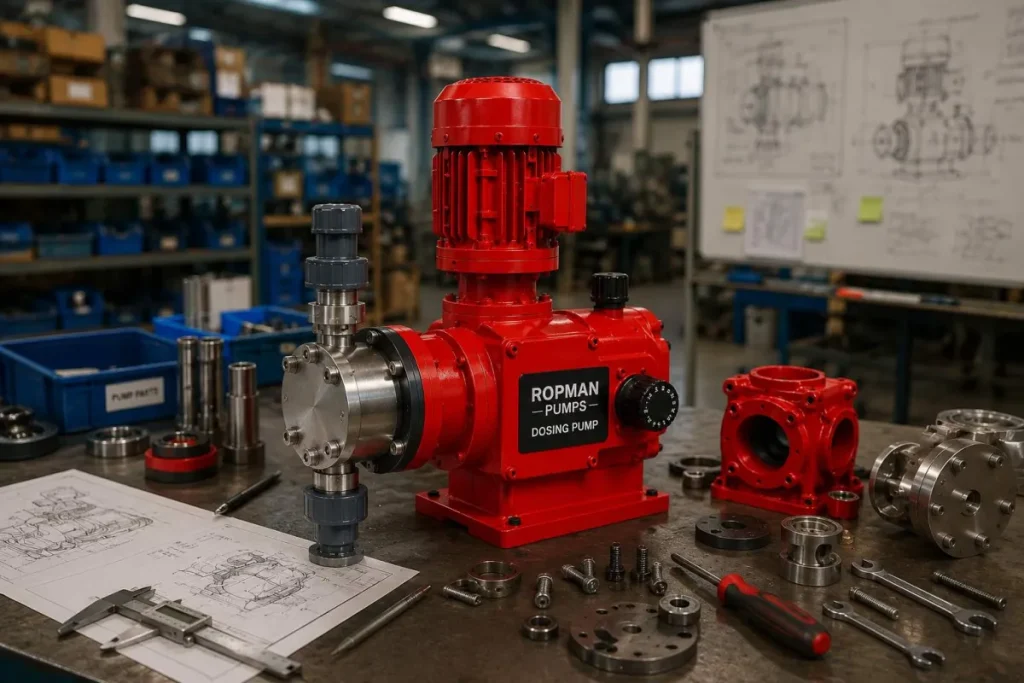
Many compliance failures start with equipment, not process design. A clogged sludge pump lets sludge build up in the clarifier until solids spill into the treated water. A failed dosing pump stops disinfection and coliform counts rise overnight.
A progressive cavity pump keeps sludge moving steadily for return, wasting and dewatering, while accurate dosing pumps deliver chlorine and polymer in the right amounts. Ropman Engineering Corporation manufactures both in Meerut, India. See our complete STP pump guide and our wastewater treatment solutions for more.
Consent to Establish and Consent to Operate
CPCB STP norms are enforced mainly through two permissions issued by the State Pollution Control Board under the Water Act, 1974.
Consent to Establish (CTE)
Obtained before construction. The application describes the project, sewage generation, proposed STP capacity and technology, treated water quality and disposal or reuse route.
Consent to Operate (CTO)
Obtained before the plant starts operating, and renewed periodically. It lists the exact discharge limits, monitoring frequency and reporting conditions your plant must follow.
The CTO is the document that matters day to day. If its limits are stricter than the national notification, the stricter limits apply to your plant. Keep a copy in the plant room and make sure operators know the numbers.
How Treated Water Is Sampled and Tested
Compliance is only as reliable as the sample. Poor sampling can make a good plant look bad or hide a real problem.
- Sample point: take samples from the final outlet after disinfection, at a fixed, accessible point.
- Grab or composite: a grab sample is a single sample; a composite sample mixes several samples over a period and better represents average quality.
- Containers: use clean bottles supplied by the laboratory, with sterile bottles for coliform testing.
- Preservation: keep samples cool and deliver them to the laboratory quickly, as BOD and coliform results change with time.
- Approved laboratory: use a laboratory recognised under the Environment (Protection) Act or accredited, as your consent requires.
- Records: file every report with the date, time, sample point and parameters tested.
On-site tests such as pH, DO, residual chlorine and turbidity give daily control, while laboratory tests for BOD, COD, TSS and coliforms provide the compliance record.
Norms for Reusing Treated Sewage
Discharge limits tell you what may be released to a drain, river or land. Reuse often needs better quality, because people may come into contact with the water. Requirements depend on the use and on state and city policies, many of which now encourage or require reuse of treated sewage.
| Reuse Application | Typical Quality Focus |
|---|---|
| Toilet flushing | Low turbidity, no odour, reliable disinfection, low colour |
| Gardening and landscaping | Low pathogens, controlled suspended solids |
| Cooling towers | Low suspended solids, controlled hardness and nutrients |
| Construction | Low solids, disinfected |
| Industrial process use | Often RO-treated to specific quality |
Tertiary treatment, such as pressure sand and activated carbon filtration, ultrafiltration and UV or chlorine disinfection, bridges the gap between discharge and reuse. For a residential context, see our guide to the STP plant for apartments.
Upgrading an Old STP to Meet Stricter Norms
Plants designed for older, looser limits often struggle with today’s CPCB STP norms and with tighter consent conditions. Common upgrade options include:
- Adding MBBR media to existing aeration tanks to improve BOD removal and capacity.
- Creating anoxic zones or switching to SBR cycles for nitrogen removal.
- Chemical phosphorus removal with alum or ferric dosing, using accurate dosing pumps.
- Tube settlers or better clarifiers to reduce TSS carry-over.
- Tertiary filters and membranes to reach very low TSS and turbidity.
- Improved disinfection with automated chlorine dosing or UV to control coliforms.
- Better sludge handling so solids are removed before they spill into treated water.
Our MBBR vs SBR vs MBR comparison explains which technologies make tighter limits easier to meet.
Which Stage Controls Which Parameter?
When a parameter goes out of limit, knowing which stage controls it speeds up troubleshooting.
| Parameter Out of Limit | Stage to Check First |
|---|---|
| High BOD / COD | Aeration: DO, MLSS, sludge age, blower and diffuser condition |
| High TSS | Clarifier or tube settler, sludge wasting, filter backwash |
| High faecal coliform | Chlorine dosing pump, contact time, UV lamp condition |
| pH out of range | Inlet contamination, chemical dosing, nitrification |
| High nitrogen | Anoxic zone, DO control, sludge age |
| High phosphorus | Chemical dosing rate and mixing |
Documents to Keep Ready for Inspection
Compliance file:
- Valid consent to operate with all conditions
- Design basis report and as-built drawings of the STP
- Monthly or periodic laboratory reports of treated water
- Daily operation logbook
- Records of sludge removal and disposal
- Treated water reuse records and flow meter readings
- Equipment maintenance and calibration records
- Any correspondence or notices from the pollution control board
A well-organised file shows inspectors that the plant is managed seriously and makes consent renewal much smoother. Meeting CPCB STP norms consistently is less about one big investment and more about steady, documented operation every day.
Frequently Asked Questions
What are the CPCB norms for STP treated water?
What is the BOD limit for STP in India?
What are the NGT norms for STP?
Who enforces STP norms in India?
How often should STP treated water be tested?
What is the difference between CTE and CTO for an STP?
Are reuse standards stricter than discharge standards?
How can an old STP meet stricter norms?
Stay Compliant with Reliable STP Pumps
Clogged sludge pumps and failed dosing pumps are common causes of norm failures. Ropman builds progressive cavity and dosing pumps that keep your STP within limits.
Request a Quote